
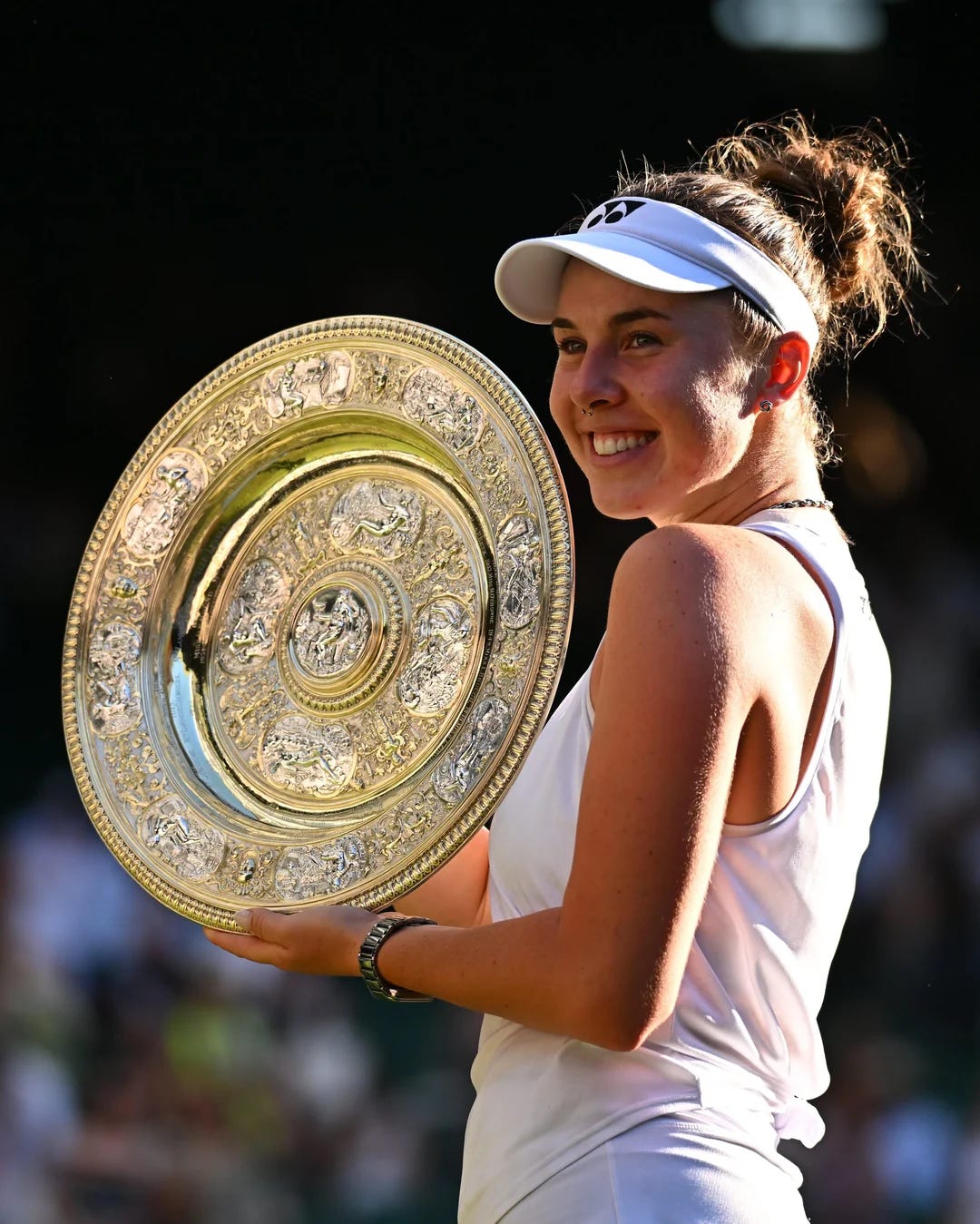
Linda Noskova is the Wimbledon champion.
The 21-year-old defeated fellow Czech player Karolina Muchova 6-2, 5-7, 6-3 in a dramatic Women’s Wimbledon Final 2026, surviving a remarkable second-set comeback to win the first Grand Slam title of her career.
Noskova appeared to be cruising towards victory after dominating the opening set and moving within touching distance of the championship in the second. But after failing to convert five championship points, she was forced into a deciding set by an inspired Muchova.
Rather than allowing the disappointment to overwhelm her, Noskova recovered, regained control of the match and converted her sixth championship point to complete the biggest victory of her career.
The final lasted two hours and 28 minutes and delivered one of the most dramatic momentum swings of the 2026 Wimbledon Championships.
Who won the Women’s Wimbledon Final 2026?
Linda Noskova won the 2026 Wimbledon women’s singles title, defeating Karolina Muchova in three sets.
The final score was:
Linda Noskova defeated Karolina Muchova 6-2, 5-7, 6-3.
It was Noskova’s first Grand Slam singles title and her first appearance in a major final.
Muchova, meanwhile, was competing in her second Grand Slam final, having previously finished as runner-up at the 2023 French Open.
Noskova dominates the opening set
Noskova made an almost perfect start on Centre Court.
Her powerful serve and aggressive groundstrokes immediately placed Muchova under pressure. Noskova consistently took the ball early, controlled the baseline exchanges and prevented Muchova from using the variety that had carried her through the tournament.
Muchova is one of the most creative players in women’s tennis, with the ability to change pace, move forward and disrupt opponents with slices and drop shots. However, she struggled to establish that style during the opening stages of the final.
Noskova raced through the first set 6-2 and continued to dictate play during the second.
At 21 years old and playing in her first Grand Slam final, there were few early signs of nerves.
Five championship points disappear
Noskova moved 5-2 ahead in the second set and appeared certain to become Wimbledon champion in straight sets.
She then created five championship points.
None of them were converted.
Muchova refused to accept that the final was over. She began extending the rallies, finding greater depth on her returns and making Noskova play additional shots under increasing pressure.
As the championship points disappeared, the atmosphere inside Centre Court changed.
Muchova won five consecutive games to take the second set 7-5, completing an extraordinary escape and forcing the final into a deciding set.
Noskova had gone from being one point away from the title to facing the possibility of one of the most painful defeats in recent Wimbledon history.
Noskova responds like a champion
The most impressive part of Noskova’s performance may not have been her power or serving.
It was her reaction.
After losing the second set from such a commanding position, many players would have struggled to recover emotionally. Noskova instead reset quickly and began the deciding set with renewed aggression.
She established an early advantage and once again used her serve and forehand to take control of the points.
Muchova continued to produce moments of outstanding tennis, mixing clever volleys and drop shots with attacking groundstrokes. But Noskova refused to allow another major momentum shift.
At 5-3 in the final set, she earned another championship point.
This time, a powerful serve completed the victory.
Noskova fell to the Centre Court grass after converting her sixth championship point, finally able to celebrate a title that had appeared to be hers more than an hour earlier.
A historic all-Czech Wimbledon final
The 2026 women’s final was historic before the first ball was struck.
Noskova and Muchova became the first two Czech players to meet in a Grand Slam singles final.
Their appearance continued the remarkable influence Czech women have had at Wimbledon. Noskova became the third Czech women’s champion in four editions, following Marketa Vondrousova in 2023 and Barbora Krejcikova in 2024.
Petra Kvitova also won the tournament in 2011 and 2014, while Czech-born Martina Navratilova remains the most successful women’s singles player in Wimbledon history with nine titles.
Noskova’s victory was therefore not an isolated breakthrough. It was the latest result from a tennis system that continues to produce technically strong, adaptable and mentally resilient players.
Noskova becomes youngest champion since Petra Kvitova
At 21, Noskova became the youngest Wimbledon women’s singles champion since Petra Kvitova won her first title in 2011.
She was also the ninth consecutive first-time women’s singles champion at Wimbledon, highlighting the extraordinary competitiveness and unpredictability of the current women’s game.
Noskova entered the tournament ranked 12th in the world and seeded ninth.
She had already shown strong grass-court form before arriving at Wimbledon, winning a WTA 500 title in Berlin and building one of the best recent grass-court records on the women’s tour.
Her Wimbledon run included victories over Ella Seidel, Camila Osorio, Sorana Cirstea, Madison Keys, Elise Mertens and Marta Kostyuk before facing Muchova in the final.
The title represents a major breakthrough, but it does not feel like a completely unexpected one.
Noskova has long been viewed as one of the most talented players of her generation. Her combination of power, clean ball-striking and a dangerous first serve gives her the ability to compete on every surface.
Now she has the Grand Slam title to prove it.
Another painful Grand Slam final for Muchova
For Muchova, the defeat will be difficult to process.
The 29-year-old produced an outstanding tournament, defeating three former Grand Slam champions—Barbora Krejcikova, Naomi Osaka and Coco Gauff—during her journey to the final.
Her semifinal victory over Gauff was one of the matches of the tournament. Muchova survived a third-set match point before winning a dramatic deciding tiebreak 12-10.
She then demonstrated similar resilience in the final, saving five championship points and recovering from 2-5 down in the second set.
But after losing the 2023 French Open final and now the 2026 Wimbledon final, Muchova remains without a Grand Slam title.
Her talent has never been questioned. Injuries have repeatedly interrupted her career, but when healthy, her all-court game makes her one of the most difficult opponents in women’s tennis.
Another opportunity is likely to arrive.
An emotional victory for Linda Noskova
The emotion of Noskova’s victory became clear during the trophy presentation.
She dedicated the title to her late mother, who died before the 2024 Wimbledon Championships, and acknowledged the importance her mother had played in helping her reach the highest level of the sport.
It added a deeply personal dimension to an already remarkable victory.
Noskova had not simply won her first Grand Slam final. She had recovered from one of the most difficult situations imaginable, after holding five championship points and watching the match seemingly slip away.
Her ability to respond in the deciding set revealed the composure of a far more experienced champion.
What next for Wimbledon champion Linda Noskova?
Winning Wimbledon will transform Noskova’s career.
She will move further up the WTA rankings, become one of the most recognisable players in women’s tennis and enter future Grand Slam tournaments as a genuine title contender.
The bigger question is whether Wimbledon represents a single breakthrough or the beginning of something much larger.
Noskova has the serve and power required to dominate shorter points, but she also demonstrated patience, movement and emotional resilience throughout the tournament.
Those qualities should make her dangerous well beyond the grass-court season.
The Women’s Wimbledon Final 2026 may ultimately be remembered as the moment Linda Noskova moved from promising young player to global tennis star.
She did it the difficult way.
Six championship points.
Three dramatic sets.
And one unforgettable first Grand Slam title.